
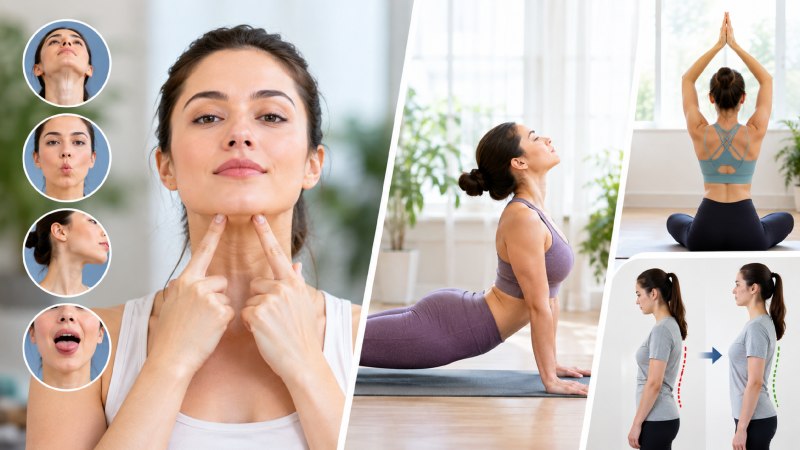
Facial appearance and body alignment are influenced by a combination of individual anatomy, muscle use, movement habits, and overall lifestyle. While these factors are different, both facial exercises and yoga can encourage greater awareness of how the body is positioned and used. Targeted face yoga for double chin can involve controlled movements that engage the jaw, chin, and neck area, although results vary and facial exercises cannot selectively remove fat. At the same time, alignment-focused yoga for posture can help practitioners become more aware of spinal position, shoulder placement, and balance. Together, these practices offer a practical approach to movement without relying on unrealistic promises about appearance or physical correction.
How Face Yoga Can Support the Appearance of a Double Chin
For people exploring targeted face yoga for double chin, controlled facial and neck movements can help engage muscles around the lower face while encouraging awareness of posture and positioning. A double chin can have several contributing factors, including genetics, anatomy, age-related changes, and overall body composition, so facial exercises should not be presented as a guaranteed way to remove it.
Chin Lift – Encourages engagement through the front of the neck and underside of the jaw.
Jaw Release – Uses controlled jaw movement to promote awareness and mobility around the lower face.
Neck Stretch – Gently lengthens the front and sides of the neck while encouraging comfortable range of motion.
Tongue-to-Palate Hold – Engages muscles around the jaw and lower face while promoting awareness of facial positioning.
These movements are best performed slowly and without excessive pressure on the jaw or neck. Consistency may help improve familiarity with the movements, but visible changes can differ considerably between individuals. Facial exercises are most appropriately viewed as a complementary practice rather than a substitute for broader approaches to health or aesthetic concerns.
Which Yoga Poses Can Encourage Better Postural Awareness
For those interested in alignment-focused yoga for posture, the value often lies in developing awareness of how the head, shoulders, spine, pelvis, and feet relate to one another. Yoga can help practitioners explore controlled alignment while building mobility and strength in different areas of the body. Rather than forcing the body into a rigid position, the aim is to develop a more comfortable and sustainable way of moving.
Mountain Pose – Builds awareness of balanced standing alignment from the feet through the spine.
Cobra Pose – Encourages controlled spinal extension while opening the front of the shoulders and chest.
Locust Pose – Strengthens the back-body muscles involved in maintaining an upright posture.
Cow Face Arms – Creates a shoulder-opening movement that can encourage awareness of upper-body positioning.
Postural awareness extends beyond the yoga mat. The way someone sits at a desk, uses a phone, stands for long periods, or carries everyday items can influence movement habits. Practising alignment through yoga can therefore be useful when combined with regular movement and conscious adjustments throughout the day.
How Everyday Habits Influence Alignment and Facial Movement
Yoga practice can be supported by paying attention to everyday movement patterns. Spending extended periods looking down at a phone or sitting at a desk can encourage the head and shoulders to move away from a neutral position. Taking regular movement breaks, changing positions, and occasionally checking shoulder and head alignment can help reduce the tendency to remain in one posture for too long.
Facial and jaw habits can also be worth noticing. Clenching the jaw, holding tension around the mouth, or repeatedly tightening the facial muscles may contribute to unnecessary strain. Keeping the jaw relaxed when it is not being used for speaking or eating can encourage more comfortable facial movement.
Rather than trying to maintain a perfectly upright position throughout the day, aim for variety. Alternating between sitting, standing, walking, and gentle mobility allows different muscle groups to move and reduces prolonged static positioning. Simple awareness of how the body feels can be more sustainable than constantly correcting posture.
How Beginners Can Build a Consistent Practice
Beginners can start with a small selection of movements and focus on performing them with control. Facial movements should be gentle, particularly around the jaw and neck, while yoga poses should be performed within a comfortable range. Forcing the neck backward, overstretching the shoulders, or holding a position despite discomfort can make the practice counterproductive.
Consistency is more useful than trying to achieve visible changes quickly. A manageable practice can gradually improve familiarity with movement, balance, and alignment. Facial exercises may support muscle engagement, but they should not be expected to produce identical results for everyone, particularly because facial structure and body composition vary naturally.
It is also important to distinguish postural awareness from permanently holding the body in one fixed position. Healthy movement involves changing positions and allowing the body to adapt to different activities. If someone experiences persistent jaw, neck, shoulder, or back discomfort, professional assessment can help identify the underlying issue and determine appropriate movement strategies.
Conclusion
Facial movements and yoga can complement broader movement habits by encouraging muscle awareness, controlled mobility, and better attention to alignment. A practical approach focuses on comfortable technique and consistency rather than promising rapid aesthetic or corrective results. Paying attention to everyday positioning can further reinforce what is practised on the mat. With realistic expectations and gradual progression, these practices can become useful additions to a balanced movement routine while respecting individual differences in anatomy and physical needs.